sobosuba quick start
Each turn gives you one numbered jelly. Your immediate job is simple: launch it into the container and make it touch another jelly with the same value. Two matching jellies merge into one larger value. Merging clears an object from the pile, awards points and gives you more room for the next shot.
The run continues until the pile remains too high. You are not racing a timer, so pause before every release. Check the current value, look at the next value, choose a target and decide whether the shot should place gently or rearrange the stack.
Mouse and touch controls
On a phone or tablet, press the waiting jelly with one finger. On desktop, press and hold the primary mouse or trackpad button. Drag in the direction opposite the shot, then release. The aiming line shows where the jelly will initially travel.
A short pull produces a controlled shot. It is useful when the matching value is exposed or when you want to land in a narrow pocket without disturbing nearby pieces. A longer pull produces more speed. That extra force can compress a soft jelly, shift a row or reach a difficult side of the container, but it also makes the landing less predictable.
Beginner habit: start with short pulls. Add force only when the target is far away or the pile must move. Accuracy creates more merges than speed.
Merge values and scoring
The value sequence doubles: two 2 jellies become 4, two 4s become 8, then 16, 32, 64, 128 and 256. A jelly cannot merge with a different number. A 4 may support an 8 or bounce off a 2, but neither contact changes its value.
Stable contact matters. A fast glancing hit may separate before a merge can resolve, while a well-placed shot settles against its match. When a merge completes, the new jelly appears around the contact point and the surrounding pile reacts to its size and momentum.
Consecutive merges form a chain. The chain readout rises when another merge happens before the previous action has fully gone quiet. Chains increase the reward and often create room quickly, but they are usually the result of good pile preparation rather than a lucky hard shot.
Read the game board
Current and next values
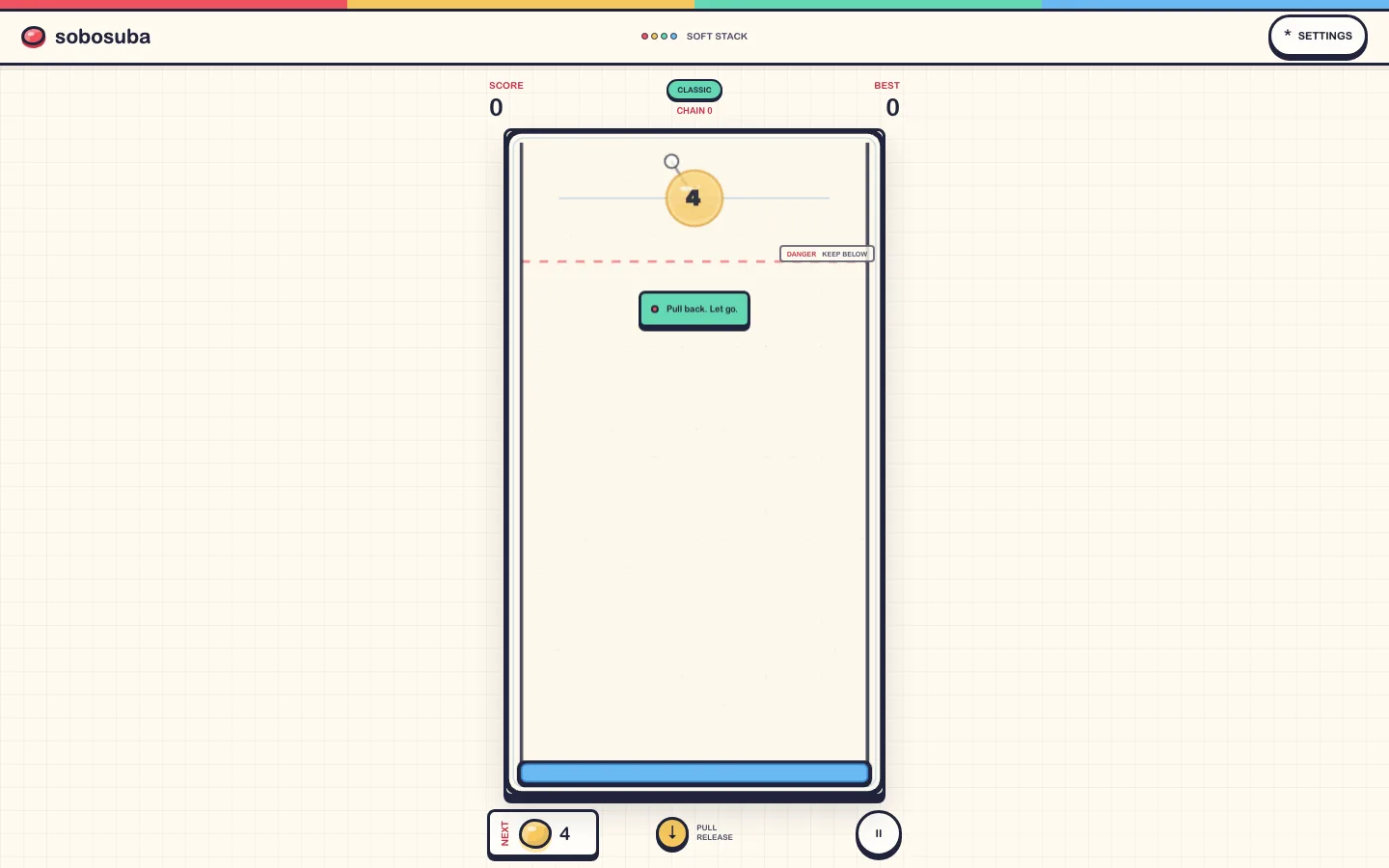
The jelly waiting above the container is your current shot. The NEXT panel below the board previews the following value. Use both pieces of information. If the current 2 can merge on either side, place it where the next value will have a useful landing rather than taking the first available match.
Score, best and chain
SCORE tracks the current run. BEST is saved in the browser on that device. CHAIN reports the active merge sequence. These numbers are feedback, not instructions: protecting playable space is more important than forcing one risky combination for a few extra points.
The danger line
The marked line near the top is the critical limit. A jelly can pass through the upper area during a shot, but a crowded pile that stays there is dangerous. Create a merge, open a lane or use measured force to settle the stack lower before adding another large piece.
A plan for your first run
- Keep the center usable. Do not fill the middle with unmatched values. An open central lane gives future shots more options.
- Pair small values early. Exposed 2s and 4s are easy to combine. Leaving many singles creates clutter.
- Build from a stable base. Larger values belong lower in the pile, where they are less likely to roll across a later target.
- Check NEXT before aiming. Plan two shots as a pair whenever possible.
- Stop using maximum force by default. A quiet landing is easier to read and preserves prepared matches.
When the pile becomes uneven, avoid firing repeatedly at the highest point. Look for a merge near the base, a matching pair separated by one obstacle or a low side pocket. One controlled merge can remove support and let several pieces settle.
Pause, restart and game over
The pause button stops an active run and opens resume, settings, restart and home controls. Settings include sound effects, music, haptics, reduced motion and visual quality. Reduced motion changes presentation effects; it does not remove the soft-body behavior that determines gameplay.
At game over, you can immediately play again or share the score. Restarting clears the current pile but keeps your saved best score and preferences. If a run feels chaotic, a restart is also a useful way to practice gentler openings.
What to learn next
Once the controls feel natural, read the sobosuba strategy guide for lane management, recovery moves and chain setup. The soft-body physics guide explains why compression, rebound and support make apparently similar shots produce different results.