The short answer
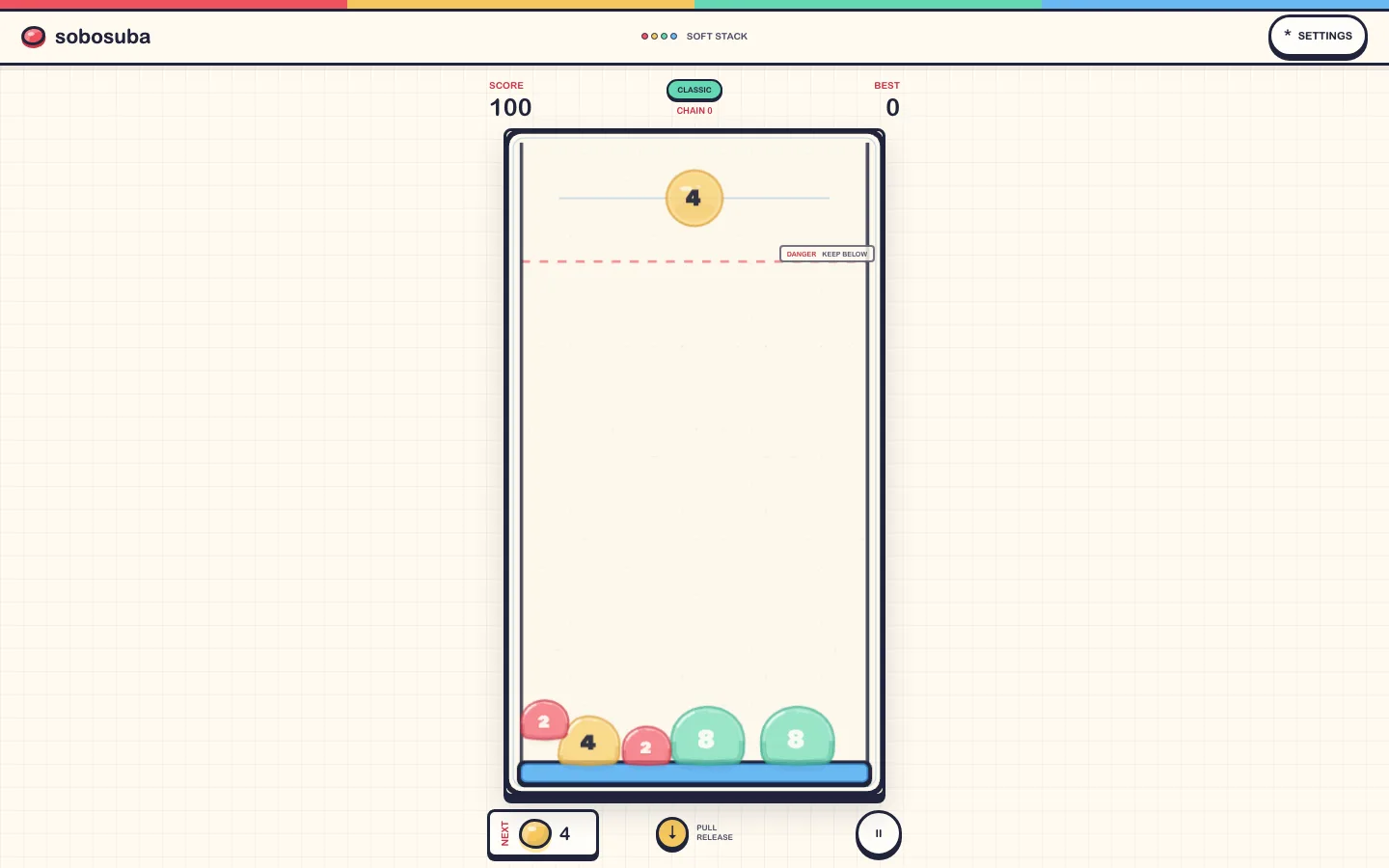
Players often discover sobosuba while searching for a 2048-style merge game, a Suika-style game or a browser version of a watermelon merge game. The comparison is useful, but it should start with the differences. sobosuba uses equal values that double, just like a familiar number puzzle, and it asks you to manage a growing container, like a fruit-pile game. The defining action is different: you aim a squishy jelly, choose launch strength and watch a pressure-supported soft body settle. It is free online and requires no download.
That means a good move has two parts. First, choose the value relationship you want: a pair, a chain or a safe place for an awkward next piece. Then choose the physical approach: a gentle placement, a firm push or a recovery shot that moves the base. The board is not a fixed set of cells, so the same value can be safe in one shape and difficult in another.
What sobosuba shares with 2048
2048 is built around a clean doubling ladder. Two equal tiles combine, the board opens a little space and a higher tile creates a new planning problem. sobosuba keeps that readable rhythm: two 2 jellies become 4, two 4s become 8 and the sequence continues through larger values. A merge is satisfying because it both clears one object and changes the future target.
The strategic lesson also transfers. Do not judge a move only by its immediate score. A merge can be mathematically correct and still leave a poor future position. In sobosuba, preserve a route for the next jelly, keep a useful pair exposed and avoid creating a tall cap that hides the lower pile. Thinking one or two moves ahead is valuable in both games.
Where the 2048 comparison stops
2048 moves tiles across a predictable grid. A sobosuba jelly has no single cell and no guaranteed landing coordinate. It can compress against a neighbor, roll down a slope, rebound from a wall or transfer load through several contacts. You are not choosing only a destination. You are choosing an impact and accepting a range of physical outcomes.
For a 2048 player, the biggest adjustment is to stop expecting a perfect grid plan. Read the visible shape, make a small correction with launch force and let the pile settle before committing to the next move. The number sequence is familiar; the timing and contact are not.
What sobosuba shares with Suika Game
Suika Game is the well-known fruit-combining puzzle in which matching fruits grow into larger fruits while the container becomes harder to control. In English searches, players may also call this a Watermelon Game or a watermelon merge game. The useful shared idea is pile planning: every new object consumes room, and a merge can create a larger object that reshapes the available space.
sobosuba asks the same broad question in a different material language: where can the next piece land without pushing the pile above the danger line? Keep a low base, leave a lane for an unmatched value and avoid sealing the only route to a useful pair. When the board is crowded, a safe merge is often more important than the highest possible chain.
Where the Suika comparison stops
In a fruit-pile game, the drop angle and rolling behavior matter, but sobosuba makes aiming and force an explicit part of every turn. You pull away from the intended direction and release. A short pull helps a jelly settle into a narrow pocket. A longer pull can compress a blocker, move a row or create a chain reaction.
The pieces are also soft bodies rather than simple fruit shapes. Their contact boundaries change as they flatten and recover. A lower jelly can carry part of the load above it, and a merge can alter several supports at once. This is why sobosuba can feel calm on one shot and surprisingly active on the next: the pile remembers its shape and momentum.
Why sobosuba feels more physical
The core difference is not a cosmetic skin. Each sobosuba jelly is simulated as a connected soft body with a solved contour. On impact, its lower edge can flatten, its sides can spread and its upper surface can wobble before the material settles. The renderer keeps those changes readable with restrained squash, contact shadows and a small amount of surface motion.
That physical model creates new decisions for players coming from 2048 or Suika Game. A target that looks close may need a gentle approach because a hard impact would launch it away. A target behind a blocker may need a firm low shot so the force travels through the support network. When several jellies are touching, a merge can remove one support and let the upper group settle into a new arrangement.
The best way to learn this layer is to use the sobosuba soft-body physics guide after a few short runs. It explains compression, support load, rebound, friction and settling with examples from the browser build.
How to switch from 2048 or Suika-style play
- Keep the doubling mindset. Look for equal values and prepare the next stage, but do not assume the result will stay in one grid location.
- Keep the pile mindset. Protect room below the danger line and reserve a landing area for a value with no immediate match.
- Add a force decision. Before each release, decide whether the shot should place, open, merge or recover. Force is part of the move, not just a way to reach farther.
- Wait for useful settling. A moving target can become easier after a support shift. Rushing the next shot often turns a good contact into a miss.
- Use the NEXT preview. The current and next values form a small plan. Keep at least one route open for the next value before taking a tempting merge.
Start with gentle pulls and one simple goal: make a clean equal-value merge without disturbing the rest of the board. Once that feels predictable, try a firm shot in a low area and watch how far the pressure travels. This practice makes the difference between number planning and physical planning visible.
Common questions
Is sobosuba the same as 2048?
No. sobosuba has a similar doubling progression, but its jellies are launched into a physical pile instead of moved on a fixed grid. Aim, force and contact shape the result.
Is sobosuba the same as Suika Game or the Watermelon Game?
No. Both involve combining matching values while managing a crowded container, but sobosuba uses numbered soft jellies, direct aiming and pressure-supported collisions. The games share a family resemblance, not an implementation or affiliation.
Can I play sobosuba in a browser?
Yes. Play sobosuba in your browser with touch, mouse or trackpad controls. There is no download or account requirement. For the complete controls, start with the sobosuba beginner guide.